Andy Fox – Q&A
A conversation with one of the Isle of Man’s most experienced coaches and long-serving contributors to athletics on the Isle of Man — from athlete, to coach, to race organiser, to committee member, to mentor.
Background & Beginnings
How did your journey in athletics first begin?
School cross-country in Mid Wales in the early 1970s. I attended Newtown High School, which for fifteen years or more was the venue for the Welsh Schools Cross Country Championships, though I was unaware of this at the time in 1971. Our PE teachers would prepare us for running with two runs a week over about an eight-week period. That is where it all began for me: no coaching, no club, no help apart from PE lessons and a desire to do better each time I ran.
Before coaching, you were a strong athlete yourself — what were your main events, and what achievements stand out from your running career?
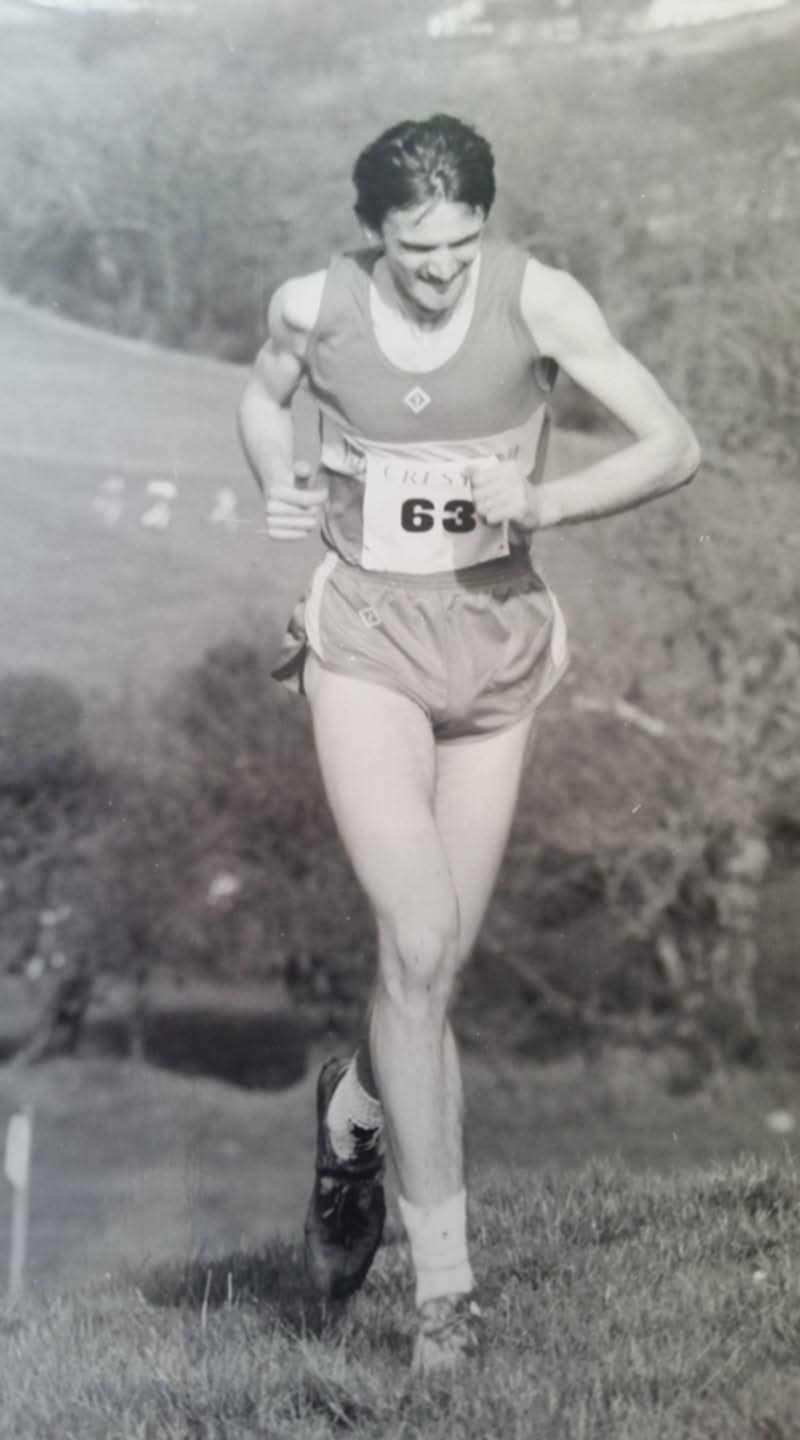
I loved cross-country and, on the track, the steeplechase. I was a bit of an all-rounder—I could jump, sprint, hurdle, and had good endurance. Indeed, I could turn my hand to most sports as a youngster. The chase suited me well. My main achievements were winning the Welsh Schools’ steeplechase two years in succession and the 1978 Welsh Under-20 Steeplechase Championships. In the 1989 Island Games, I won the 10,000m gold in what was then a record time. I represented the Isle of Man in the North Wales v Shropshire v the Island cross-country match, where I came 2nd twice and 5th once. I was UK Vet 40 steeplechase champion in 2000 and won other lesser medals in my 40s. I was the top-ranked chaser as a veteran from 2000 to 2006, and a bronze medallist in the European Vet 45 chase in 2006. I ran for Wales on the track and cross-country as a teenager, as well as for GB as a veteran on the track in the Interland event. I am still the Manx record holder in the chase, 33 years after running the time at Stanley Park, Blackpool, in the Northern Men’s League. I hold just about all steeplechase age-group records for men (not junior records, as I lived in North Wales then). One target I have presently is to set a vet 65 record if I can get fit enough to do a chase safely!
Was there a particular coach or figure who inspired you during your competitive years?
I did not really have a coach. I had PE teachers who showed interest in me at Newtown and Colwyn Bay—Mr Evans at Newtown and Mr Kyffin at Colwyn Bay. The rest I did mainly for myself, with help from my parents. In some ways, I regret this a little, as I think I had the determination but was not really guided or helped. I just did what I thought was right and had some success along the way. It was not until I worked with Maurice Herriott in the late ’80s that I really got to see what a coach could offer. He was a silver medallist at the Olympics in the chase, so he inspired me in my late twenties.
As a coach, I have had to retake my coaching exams twice due to UKA reorganisations. This led to me meeting other coaches and tutors along the way. Four made a big impact upon me:
- Jeremy Harries – a tutor on one of my coaching courses, my Lancashire Team Manager when I ran in Inter County events in the late ’90s. Unbeknown to me at the time, he was coach to Commonwealth bronze medallist John Nuttall as well as Helen Clitheroe (later Patterson), a GB international. His calm and scientific approach made a big impact on me. I still use sessions and ideas he shared with my athletes.
- George Gandy – The great coach at Loughborough College, now University, who was a real motivator and deep thinker. I saw him at several conferences and always found him an interesting listen. I still use some of his sessions with athletes along the way.
- Don Nichol – A coach at Altrincham who came over to the island a few times at the invite of Chris Quine to share coaching ideas and techniques. Another calm and intelligent man, I picked up much from him also.
- Merrick Bousefield – A throws coach at Liverpool Pembroke. He showed me a different world behind the hammer cage that I never knew existed. His calm and knowledgeable approach I found inspiring. His untimely passing was a great loss to athletics in the North West.
On the Island, I have learnt much from Di Shimell, John Whitlow and Chris Quine. Each has influenced me and my ideas in many ways. I am not sure they realise this, but I would like to thank them for their support and help along the way.
Coaching Career
How long have you been coaching, and how has your coaching philosophy developed over the years?
I could talk about this for hours, so I will try to give a brief outline. I took my first coaching qualification over December 1980 into January 1981. I was injured at the time and came home to North Wales from college for the two weekends, which were taken by the then Welsh National Coach, Malcolm Arnold. He was a hurdles coach who helped John Akii-Bua win the 1972 400m hurdles gold medal at the Munich Olympics and later also coached British great Colin Jackson among many others. Here was this great man working with a few people like me in a small town in the sticks. He was very interesting, and this meant that for several years, my university holidays involved coaching as well as my own training. I think I was always destined to become a teacher. My roles as a coach and a teacher have often overlapped in so many ways. I qualified as a teacher in the summer of 1982.
The development of my philosophy is where the discussion could take hours. Let’s say at this stage I see coaching and teaching as intertwined. I have coached individuals from very young years through to adulthood and beyond if one considers I have athletes working with me in their 60s. My main aim is to help development and progression as well as the athlete’s understanding of their event and themselves. The aim is that over time they no longer need me, and in fact I become a trusted person they can speak to for help or guidance when needed, i.e. I have removed the need for me as a coach. I always make a commitment in my mind to my athletes. I have to say I find it hard when they move on but try to keep this to myself. Coaching is about the athlete and what they think is best for them. If that means moving on, then so be it. Of course, they can always come back.
The other element I feel is worth saying is the process is more important than the outcome in the coaching scenario. Outcomes are important as goals in races and competitions. You cannot always hit times etc. in training sessions, but you can learn and develop as a person and an athlete. Athletes are preoccupied with PBs etc. However, you cannot always perform at your very best for a myriad of reasons; however, you can always give your best on the day and take the positives to move forward and progress in future. All athletes are an experiment of one, so take the positives from every experience, as there will always be negatives. The athletes we want to be are developed by how we cope with the issues we face along the way.
What do you enjoy most about being a coach?
Working with younger people or just people in general. I think it keeps me with a younger outlook on life and that feeling of progression and development is integral. I love seeing the progression and development over a season or over many years. Knowing you have helped by being a small part of this development is inspiring. Of course this is not just athletically, developing as a person is also a big part of the story.
What do you think are the key qualities of a good coach?
Listening, knowledge and experience, being a good planner, knowing how to get to target A in great shape whilst also being flexible enough to overcome obstacles along the way. Knowledge of the athlete, nutrition, psychology – not necessarily being an expert but having enough understanding to help and being able to suggest ways forward and who to approach for further guidance. I was lucky enough to work with an excellent athlete in the early days of Sport Aid. We were asked what he needed to progress, and our answer was guidance on nutrition, strength training, physiotherapy, sports psychology, etc. Interestingly, this is now the offer IOM Sport gives to Sport Aid athletes. The days of coaching being the responsibility of one person have gone. At the top level, and even further down the pyramid, it is often a team behind the athlete.
Every athlete is different — how do you tailor your approach to suit different personalities, ages, and abilities?
I think this is where experience comes in. I have seen athletes of many abilities and, hopefully, helped them to achieve their goals, or at least to partially do so. I think it is vital that I understand what the athlete wants to achieve. Then I need to work with them over time and get to know them. I see one-to-one meetings as vital in all of this, where we share our views, our goals and aspirations, and then work out a plan together, attempting to achieve them and perhaps identifying other help needed to get there. I hold meetings, sometimes three or four times a year with athletes, to enable the above to happen.
What do you see as the biggest challenges facing athletes today compared to when you first started coaching?
There are so many experts now, as opposed to so few in the early ’80s. We have access to so much on the internet, and yet do we really know what we are reading or doing today? I think we are losing the personal touch, which is a shame. I recall the late ’80s, working with groups of runners as another runner, and working to achieve success in particular events. I feel today we have an issue with athletes striving to achieve (which is great) but not being part of a club or group and following the latest plan online. Does it really suit them? Perhaps not. Would they benefit from another set of eyes looking at what they are doing and giving advice? Probably, yes. However, today there seems to be a reluctance to join a club or approach a coach. I do worry that, over time, we may lose the bedrock of athletics – the clubs that basically make it all happen. This would be a great shame, and our sport will not exist if that is where this all goes. Clubs are not full of elite athletes and no one else. They are communities of like-minded people trying to achieve their best for themselves and their group. We need more people to get involved for the future of our sport and their own development, in my view.
One last point – I will never approach an athlete and say I am happy to coach you, or I should be coaching you, or you should join my group. The etiquette of athletics is that the athlete, or their family for a junior, should approach the coach and discuss the idea of joining forces.
Manx Harriers & Local Athletics
You’ve coached many athletes through Manx Harriers across multiple generations — what does the club mean to you?
So much. It is hard to say in many ways. The club has helped me, and I hope I have helped it. As stated in my last reply the clubs are the foundation athletics is built upon. Our club has a fantastic group of volunteers who do so much for Manx Athletics not just our club and keep it going. However, our senior numbers are depleted, we need people to help in greater numbers. I do worry where things will be in twenty years’ time. Having said how much the club means to me, if a move to amalgamate clubs on the IOM was successful, I would support it fully. I believe we really need to make more efficient use of our resources on a small island.
What changes have you seen within Manx Harriers and Isle of Man athletics during your time involved?
I will start with the positive – fantastic coaching opportunities for athletes across all disciplines. Years ago, we might have had a distance coach, walks coach and a sprints coach and that was it. Manx Harriers can now boast coaches across every athletics discipline, and we have more coming through. This is great for young athletes today and older ones wishing to try a different event. Not many clubs in the UK can make such a boast!
The negative is the fact if you look at our club, the people organising races, running committees and other such admin tasks are pretty much the same as 20 or even 30 years ago. We need more people to volunteer and come forward. In addition, we can see this as well with the fall in the number of senior athletes at Manx Harriers and the corresponding rise in unattached athletes. I am not sure why this is the case. Do people see athletics clubs for the elite only as stated earlier – if so, they are way off what the clubs want to try and do. I guess we need to sell ourselves more successfully out there. Whatever the reasons, I feel we have a major issue to address here as a sport and as a club.
What makes the Isle of Man such a strong environment for producing talented athletes?
Well, at the top end, good support comes through Sport Aid and Isle of Man Sport. That is part of the equation. I think great coaching is also a key factor. We have some excellent coaches doing great work every week. We also have strong financial foundations at present. In other words, our clubs raise money and invest it in athletes through coaching, travel, putting on events, etc. In all these ways, our sport is doing well. I have already mentioned the threats to this, but overall, the picture is positive. On top of this, I think our athletes have responded well to the challenges. There is a definite positive mindset among local athletes—a “we can overcome” mentality. You see it so often. Only this morning, I was reading about a group going to race in an indoor event, having to change arrangements at the last minute just to get to Manchester due to the weather. No whingeing, no complaining—just “we will get there no matter what and do what we want to do.” Compare that to some parts of the UK, where the weather is poor on the day of the race. It is 90 minutes away by car. “I do not think I will bother this week.” We must be organised and committed. This, I feel, means our athletes are well prepared for the challenges they face.
How important is the community aspect within Manx Harriers and the wider athletics scene?
I think very important. When you go to our presentation evenings and events there is a lovely atmosphere. Our coaches, organisers, volunteers, athletes and members are truly a positive group.
Roles Beyond Coaching
You’ve held various roles within Manx Harriers and Isle of Man Athletics — can you share some of those responsibilities and what they involved?
I am presently Manx Harriers Coaching Co-ordinator, Committee Member, Safeguarding Officer and a member of the IOMA committee. I think the roles above are all self-explanatory.
I have been the club Chairperson for seven or eight years over two stints—once in the late 90s and then again in the recent past. I was Chair of the IOM Athletics Development Committee in the early 2000s and have been IOMA Island Games Team Manager. Before I took on this role, I also raised money for our Island Games teams, which I did from 1993 to 2009.
Presently, I organise several races, help with the IOM and MH Track and Field Leagues, and I also organise the IOMA Cross Country League, currently sponsored by Group Eleven. I also organise between two and four cross country trips for our athletes to compete in at the County and National Championships in the UK.
Again, I think it is obvious what all these roles entail. I do enjoy organising things, which I guess explains why I seem to end up taking on so many roles.
How did you balance administrative duties, organising events, and coaching simultaneously?
I believe you can achieve many things in life as well as sport etc. I think I am fairly organised mentally so can prioritise easily what needs doing and what can wait.
How important are volunteers and club officials in keeping athletics on the Isle of Man functioning and thriving?
They are vital, and this is an area I worry about greatly, as mentioned earlier. I feel we must continue to push and develop this area for the success of our sport. I believe our IOM ADO is doing great work in this area, and I am happy to help and support as and when I can.
Athletes & Achievements
Are there particular athletes or squads you’ve coached that stand out as especially memorable?
I have to say I am a little unsure about answering this question, as I would want to check with the athletes that they are happy for me to include them in my answers. Their view may be very different to mine. I would hope it would not be, but I cannot be sure. As such, I will mention teams and events where the IOM has been successful.
Firstly, I am very proud of the fact that I have coached athletes who have gone on to become IOM record holders, Manx Champions, Lancashire Champions, England and GB representatives, and even medallists in international events. Some of these were achieved when I was coaching the individual, and some went on to achieve success with their next coach, but it is nice to know I was part of their story.
I have helped many Lancashire Cross Country Champions and many Lancs Championship-winning teams.
I often look back at the Manx Harriers ladies’ team of the early 2010s. The team came 7th in the English National XC Champs and won bronze medals in the North of England XC Champs. These are brilliant performances from all involved when one considers what a small club, we are compared to the clubs we compete against in the UK.
Our men’s teams have not done quite so well, but we have been 20th and 22nd in the English National XC Champs 6-man team race, and 11th in the 9-man event in 2007. These are great results for a small club and, if one uses a football analogy, are just in the Premier League or top of the Championship. I do not think we have many teams on the IOM who can claim such a standard.
I was lucky enough to be team manager for Manx Harriers men’s track and field team when we won the North of England League promotion match and then had two years competing in Division One. This was a high standard of athletics, and we had a team capable of competing at that level.
I was IOM Athletics team manager in 2007 and 2009 and have to say it was a delight being the manager for those teams. Much of the work we did then has become the foundation for later Island Games success.
I could go on but suffice to say I am always pleased to see and hear of success for our athletes—long may it continue.
What moments or achievements as a coach make you most proud?
I will share one that is a vivid memory even now. I have been to many English National XC Championships, and it always seemed like we ran in a particular area of the race and Olympians and super humans competed further up the field. How could we ever really challenge them. Well on this day at the Champs at Parliament Hill, London, I was stood on my own as a junior race took place. The rest of the group were warming up or watching on the course. I was at the finish guarding the bags. The announcer was giving updates about the race. The athletes were at the far side of the course well away from where the finish was. He said something like this “So and so is second with such and such third. The athlete in first place has a lead and is wearing red with a yellow and white trim.” They did not know the name or the club or athlete – but I did. I was jumping up and down so happy. The athlete in question came second at the end of a great race and I have to say that taught me that a little island in the middle of the Irish Sea can achieve anything if we put our mind to it.
Is there a standout race or championship performance you’ll never forget?
Apart from the above it would have to be the 2005 National Cross Country Champs when the same runner won the Junior Men’s English Championships. A very proud moment for me as coach and team manager and the start of a very successful period for that athlete, our club, and many of my athletes.
What is the most rewarding part of watching an athlete progress?
This is easy to answer. Just seeing them achieve their goals and knowing the satisfaction they get from this. I have not run an outright PB in athletics for 32 years, yet I still strive to run as fast as I can. I know what they are going through to get where they need to. The hard work makes it even more satisfying when it does lead to success – whether that success might be a PB, a medal or in some case just getting to the start line!
Coaching Insights & Philosophy
What’s the most important lesson you try to instil in the athletes you work with?
What happens today is not the be all and end all. You might run a PB or win a medal, you might struggle or fail in your eyes. All things are possible. But you are as good as your next race. Learn the lessons, dust yourself off, get up and keep believing and working. You will make the target whatever that is. Where your mind goes – everything else will follow.
How do you help athletes manage setbacks, injury, or dips in confidence?
Much is as above. Have you read the Chimp Paradox by Steve Peters? If not, do so. It is actually a self-help book. I have used the ideas in it with athletes and when I was working at school with both teachers and children. Last point as said earlier – all athletes respond differently. You need to know your athletes and work with them accordingly. With regards to injury, it is always to know good physios. I am lucky enough to have contact with a few.
What do you believe are the biggest misconceptions about training or coaching?
I think some individuals take a coaching course and believe that means they are a coach. Actually – no, this is just the start of your coaching journey. The experience you develop over time along with the technical knowledge you have is what makes you a coach. You can get so much out of the books and the courses and then you must decide what kind of a coach you want to be, how will you work with people, and how will you work in different circumstances etc.
Has your approach to training changed with modern developments such as technology, sports science, or new training methods?
Yes. I have used many new ideas along the way. I have been to several Endurance conferences in the UK and on the IOM. I have studied coaching and other coaches and learnt from them. I think this is a way of life – you are never too old to learn new things. I am always looking for the next idea or to try something different. I think much of this comes from the kind of person I am, but also from teaching for so long. There is always another way you can achieve the goal.
Looking Ahead
What goals or hopes do you have for the future of Manx Harriers and Isle of Man athletics?
Success in whatever form that takes. I hope we continue to develop great athletes, teams and have a vibrant sport. I have mentioned a few issues in this interview. I hope we can find ways through some of those problems.
Do you have any personal coaching goals left that you’d still like to achieve?
Yes – loads. I have never coached an Olympian. I would love to do so or at least been an early part in their story. It could still happen. But on the other hand, if that were to happen, or not happen, helping athletes develop and improve is basically what it is all about.
How do you see the next generation of Manx athletes developing over the coming years?
I believe they will develop well. When I look back to 1971 when I started running XC there was no help, no coaching, no club etc. Just my desire to be faster and stronger. Now we have a coaching structure, technical and strength coaches, sports psychology, nutrition etc. I think our athletes are far better supported. I hope we will see some great achievements in the next 20 years or more.
Advice & Reflection
What advice would you give to new coaches starting out today?
Get you qualifications and learn on the job. Do not be afraid to start coaching the younger athletes. They have so much enthusiasm and you will learn so much that will help you in years to come with teenagers and adults.
What message would you give to athletes — young or old — who want to progress or enjoy the sport more?
Never give up. You can achieve success as a junior, a senior or a veteran. There is always something to go for or aim at. Also, success is not just PBs and medals – it can be a great performance on a difficult day. Stay positive and go for it. Oh, and a training plan helped by a good coach will help you make the success happen more easily. Give it a try.
Looking back, what are you most proud of throughout your long involvement in athletics?
I think I got a pretty good level of success out of my own limited ability. I have helped people achieve their targets. I am satisfied with both of those areas. In addition, I feel my work as MH coaching coordinator has helped more athletes achieve their best than I could ever make happen working alone, so I am proud of what my coaching colleagues have achieved as well. It is great to be part of a brilliant team.
What does athletics mean to you on a personal level after so many years in the sport?
Oh gosh. It is so important in my life. Family first, athletics second. I tried to see athletics as being part of my job when working as certainly the coaching and teaching had so much that overlapped. However, you could change athletics to helping people achieve their dreams or goals, perhaps that is what I love most.
Quick-Fire Questions
Favourite event to coach?
Steeplechase – more than just running!
Favourite event you competed in?
Steeplechase – it is a beautiful event to watch and compete it.
Most memorable coaching moment?
Hard to say. Probably generic – when an athlete suddenly realises just what they can do, and it is so much more than they originally thought!
One piece of coaching advice you always come back to?
One performance does not encapsulate you. Enjoy the success, learn from the failures. Whether good or bad, work hard and move on to the next opportunity.
Biggest change in athletics since you started?
The effect of the internet and social media – both good and bad aspects!
Best part of being a coach?
Working with positive people who want to succeed.